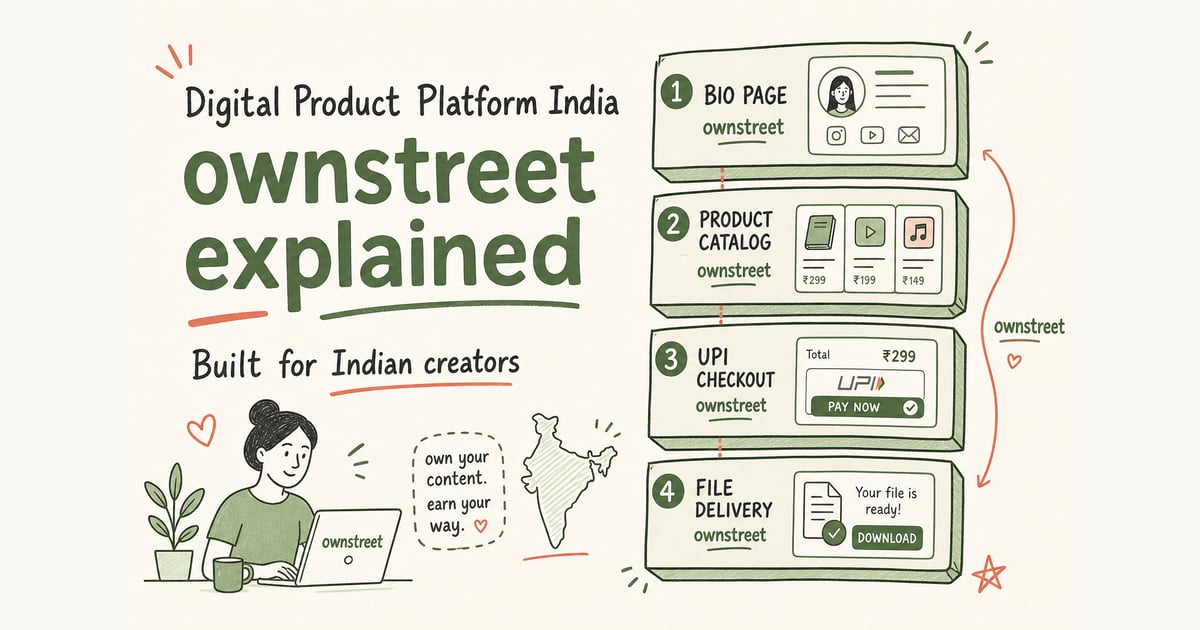
If you searched digital product platform india, you probably want clarity before you sign up anywhere. A digital product platform is software that hosts your files, shows a product page, collects payment, and delivers the download automatically. It is not the same as a bio link, a payment gateway alone, or a WordPress site you maintain yourself. This guide explains how the category works in India so you can pick the right layer of tooling without mixing up terms Google and buyers both care about.
ℹ️ Quick answer
Ready to pick a tool? Use our commercial ranking: Best platform to sell digital products India. Free-tier only: Best free platform to sell digital products India. This post explains the category first so that comparison makes sense.
What a digital product platform actually does
At minimum, a digital product platform handles four jobs in one flow: product listing, checkout, payment confirmation, and file delivery. You upload a PDF, preset pack, template, or video lesson. A buyer lands on a page, pays in rupees, and receives the file without you manually replying in DMs. Good platforms also log orders, send receipt emails, and give you a shareable URL for Instagram, YouTube, or WhatsApp status links.
- Product page: title, price in INR, description, preview image
- Checkout: UPI, cards, or wallets depending on gateway integration
- Delivery: instant download link or email with attachment
- Order record: who paid, when, and which SKU they bought
Platform vs store vs payment link: three layers people confuse
Creators often mix these up and pick the wrong tool. A **payment link** (Razorpay Payment Pages, UPI QR) only collects money. You still send the file yourself. A **digital product store** is the buyer-facing shelf: URLs, branding, multiple products. The **platform** is the software vendor that powers hosting, checkout rules, and delivery automation. Some products combine all three; others give you only one layer.
| Layer | What it solves | Example gap if used alone |
|---|---|---|
| Payment link | Collect ₹ once | No product page, no auto delivery |
| Bio link tool | Route traffic to many URLs | Weak native file delivery |
| Digital product platform | List, pay, deliver | May still need Razorpay KYC |
| Full ecommerce (Shopify) | Physical + digital catalog | Heavy setup for one PDF |
For a deeper store setup walkthrough, read digital product store India. For gateway-only questions, see digital product payment gateway India.
Four types of digital product platforms creators use in India
1. Creator-first hosted platforms
Built for solo creators: one login, product upload, shareable page, monthly subscription or low sales fee. ownstreet, Gumroad, and Payhip sit here. India fit depends on UPI support and INR pricing, not just feature lists.
2. Global marketplaces with discovery
Etsy, Gumroad Discover, and similar tools expose your product to their audience. You trade margin or listing rules for traffic you did not build. Useful as a secondary channel, rarely enough as your only India checkout path.
3. Bio-link products with a shop add-on
Linktree, Beacons, and Stan Store started as link hubs and added commerce. They work when links matter more than conversion-optimized product pages. When digital products are most of your revenue, a platform built store-first usually converts better.
4. Self-hosted or custom builds
WordPress + WooCommerce, custom Next.js storefronts, or Notion paid via manual invoicing. Maximum control, highest maintenance. Most Indian creators selling under ₹1 lakh/month are better served by hosted platforms until ops complexity justifies a dev stack.
How upload-to-delivery works on a typical platform
- Create account and connect a payment gateway (often Razorpay for Indian UPI)
- Upload file, set INR price, write product description and cover image
- Publish product page and copy your store URL into bio or WhatsApp
- Buyer pays; platform confirms payment with the gateway webhook
- Platform sends download link or stamped PDF automatically
- You see the order in dashboard and can export for accounting
First-time sellers should follow our 48-hour first sale plan. Razorpay KYC usually takes 1–3 business days, so draft products early and launch checkout once keys go live.
Checklist: what Indian creators should require from a platform
Use this before you read any comparison post. If a platform fails two or more must-haves, Indian buyers will drop off even if the UI looks polished.
| Requirement | Must-have? | Why it matters in India |
|---|---|---|
| INR pricing on product page | Yes | ₹299 beats $3.99 + forex doubt |
| UPI at checkout | Yes | Most Indian impulse buys are UPI-first |
| Automatic file delivery | Yes | DM delivery does not scale |
| Mobile-friendly product page | Yes | Bio traffic is almost all phone |
| Razorpay or trusted Indian gateway | Yes | Buyer trust + settlement in INR |
| Bio-link friendly single URL | Strongly recommended | One link in Instagram bio |
| 0% or low platform fee on sales | Recommended | Margin adds up on ₹499 products |
| Marketplace discovery (optional) | Nice-to-have | Second channel beyond your audience |
💡 Tip
Ownstreet checks the must-have row for Indian creators: hosted store + bio page, Razorpay UPI checkout, automatic delivery, 0% platform fee on sales. See pricing and start free at /signup.
When you do not need a full platform yet
- You are validating demand with 5–10 manual sales via WhatsApp and have not packaged a file yet
- You only sell live 1:1 calls, not downloads (booking tools fit better)
- Your audience is 100% international and pays in USD only (global tools may suffice)
- You already run Shopify with digital SKUs and staff to manage it
Once you repeat the same delivery more than twice a week, a platform pays for itself in time saved and fewer refund disputes from missed DMs.
Where ownstreet fits in the digital product platform stack
Ownstreet is a creator-first hosted platform: bio page, product shelf, Razorpay checkout, and free creator marketplace listing after first sale (edit from Dashboard → Marketplace). It is not a generic website builder. You do not code checkout or wire webhooks yourself. If your goal is sell downloads from social traffic with UPI, that is the job it is built for.
When you are ready to compare vendors head to head, use the best digital product platform India guide. When you are ready to build the shelf itself, use the sell digital products India UPI guide.
FAQ: Digital Product Platform in India
Is a digital product platform the same as a website?
Not exactly. A website is any site you own. A digital product platform is specialized software for paid downloads: hosted files, checkout rules, and delivery automation. You get a URL that works like a mini-site without managing servers or plugins.
What can you sell on a digital product platform in India?
Common SKUs: PDF guides, Notion templates, Canva kits, Lightroom presets, short video courses, spreadsheets, and design assets. Platforms restrict illegal or copyrighted content; check each vendor's acceptable use policy and Razorpay acceptable use guidelines before upload.
Do you always need Razorpay on every platform?
Most India-ready creator platforms connect your own Razorpay account so settlements land in your bank. Some global platforms process payments abroad, which adds forex friction. Read Razorpay setup for digital products before you connect keys.
How is a platform different from Gumroad or Linktree?
Gumroad is one platform vendor; Linktree is primarily a bio-link product with shop features added later. The category digital product platform india describes the job (host, charge, deliver), not a single brand. Compare specific vendors only after you understand the job.
How long until a new platform page gets indexed on Google?
Product pages on established domains can index in days; new creator stores depend on links from bio traffic, marketplace listings, and blog content. Publish your store URL in at least one indexed page (bio, blog, or marketplace) to help crawlers find it. Official reference: Google Search Central on indexing.
Share this post
Further reading

Lakshath
Founder, ownstreet · ownstreet
Updated Aug 2026