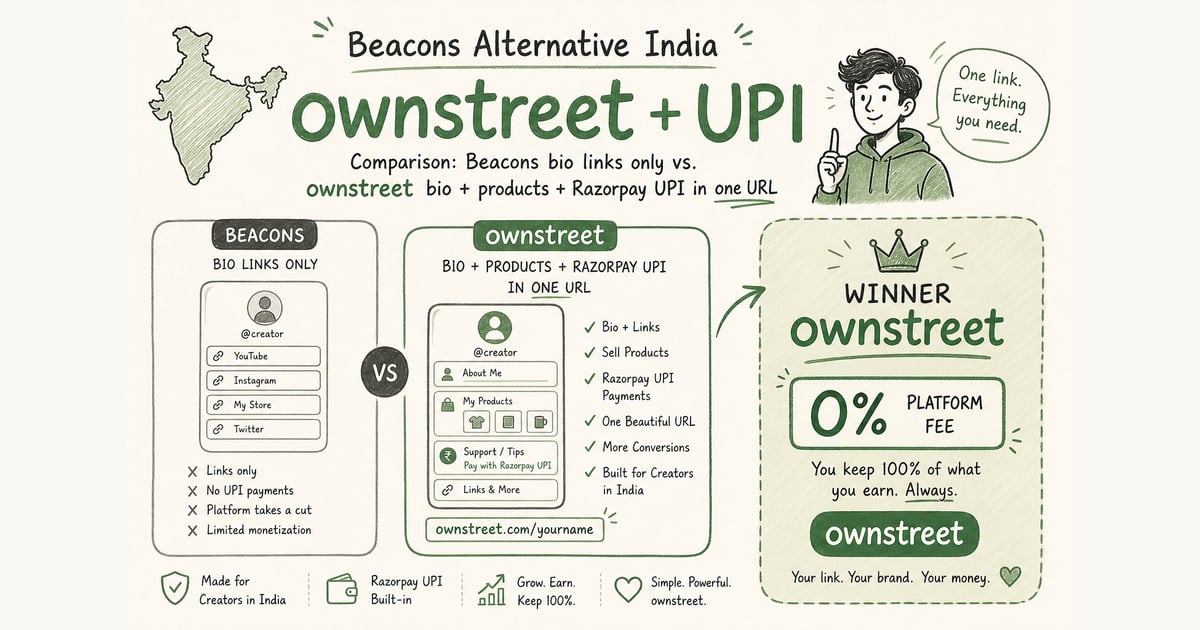
If you are searching for a beacons alternative india you can grow with, you are probably comparing more than landing page templates. You are comparing transaction fees, checkout behavior for Indian buyers, whether you can sell digital products without friction, and whether your stack stays simple as you scale. Beacons popularized the creator landing page with many modules. In 2026, Indian creators need the same ambition with India-first economics: UPI-first checkout, INR-native pricing, and one destination that turns social traffic into revenue. This guide gives you a decision framework, migration playbook, and comparison signals so you can choose confidently.
ℹ️ Quick answer
Quick answer: the best option is the platform that matches your buyer geography, reduces fee drag on sales, and unifies link-in-bio traffic with digital product selling without forcing you into multiple disconnected tools.
What Beacons does well (and why creators still look for alternatives)
Beacons is a strong product in the global creator economy. It bundles many creator workflows into one surface area: links, media kits, email capture, monetization modules, and more. That breadth is useful when you want one vendor to cover many jobs. The tradeoff is complexity and economics. When your audience is primarily Indian, you must ask whether the default checkout assumptions, currency framing, and fee structure align with how your buyers actually pay. Many creators start on Beacons because it is feature-rich, then look for an alternative when they notice conversion gaps or margin pressure at scale.
- Strength: broad feature set for creator landing pages.
- Strength: recognizable brand in the creator tooling space.
- Risk: global-first defaults may not optimize India checkout behavior.
- Risk: fee stacking can matter if you sell frequently in INR.
- Risk: broad tools can dilute focus if your main job is selling digital products.
You can review Beacons directly at Beacons before you decide what to optimize next.
Why Indian creators evaluate a Beacons alternative differently
Indian creator businesses often have three constraints that global-first tools do not always solve cleanly: payment method expectations, currency psychology, and operational simplicity. Indian buyers frequently prefer UPI. They are sensitive to unclear pricing in foreign currencies. They also expect fast mobile flows. If your landing page is beautiful but checkout feels foreign, you lose sales even when demand exists. That is not a branding problem. It is a conversion infrastructure problem.
| Constraint | What it means for your page | What to optimize |
|---|---|---|
| UPI behavior | Buyers want familiar payment rails | UPI-first checkout and fewer steps |
| INR clarity | Buyers anchor on rupee pricing | Clear INR pricing and no hidden FX confusion |
| Mobile traffic | Most bio traffic is mobile | Fast layout, big tap targets, minimal friction |
| Trust | New buyers hesitate online | Proof, refund clarity, and support visibility |
The decision framework: choose by revenue model, not by aesthetics
The wrong way to pick a replacement is to scroll screenshots. The right way is to map your revenue model. If you monetize mostly through digital products, your alternative must win on checkout completion and delivery reliability. If you monetize mostly through services, your alternative must win on lead capture and WhatsApp conversion paths. If you monetize through audience growth, your alternative must win on email capture and repeat engagement analytics.
Model A: digital products first
If you sell templates, presets, guides, ebooks, or bundles, your bio page is a storefront, not a brochure. You need product cards, pricing clarity, and a checkout path that feels native to Indian buyers. For a full operational playbook, read How to Sell Digital Products in India.
Model B: services and high-touch sales
If you sell coaching, audits, or custom work, your bio page is a lead engine. You need a strong CTA, WhatsApp routing, and optional email capture for nurture. That is why many creators pair a bio page with a clear service ladder rather than a generic link list.
Model C: hybrid creator brand
Hybrid creators sell products and services. The stack must stay unified. If your product checkout lives on one tool and your booking flow lives on another, you increase drop-off and support overhead. A unified destination is usually the highest ROI change.
Fee reality: what to compare before you switch
Fees are not just a line item. They change how aggressively you can reinvest in ads, collaborators, and product quality. When evaluating any replacement, compute monthly platform cost plus expected transaction costs at your current and next revenue tier. If you are also evaluating product-selling platforms, compare against percentage-based models in Best Gumroad Alternative India.
| Scenario | What to measure | Why it matters |
|---|---|---|
| Low volume | Setup speed + friction | You need momentum before optimization |
| Mid volume | Fees + support time | Margins compress if fees scale with sales |
| High volume | Checkout completion + refunds | Small conversion gains move big revenue |
💡 Tip
Rule of thumb: if your monthly platform plus transaction costs exceed what you would pay for a flat subscription that covers the same outcomes, you should run a 30-day migration experiment and measure net revenue, not vanity clicks.
Feature overlap: what you must not lose when you migrate
- A clean mobile-first landing layout.
- Link blocks that are easy to reorder based on analytics.
- Email capture for audience ownership.
- Digital product selling with clear delivery expectations.
- Analytics that help you decide what to promote next.
- Brand control: templates, typography, and visual identity.
If you lose any of these during migration, you can accidentally reduce conversion even if the new tool is theoretically better. Migration is a systems change, not a copy-paste exercise.
Competitive landscape: Beacons vs Linktree vs Gumroad vs India-first stacks
Most creators do not choose between two tools. They choose between stacks. Linktree is often the default for link-in-bio distribution. Gumroad is often the default for digital product selling. Beacons tries to combine many creator workflows. India-first platforms like OwnStreet aim to unify links and digital selling with local payment behavior as a first-class constraint. For a broader link-tool comparison, read Best Linktree Alternatives India 2026.
| Tool | Typical strength | Typical gap for India-first selling |
|---|---|---|
| Beacons | Broad creator modules | Must validate India checkout fit for your buyers |
| Linktree | Simple bio distribution | Often needs a separate selling stack |
| Gumroad | Digital product selling | Often needs a separate bio page and India payment fit |
| OwnStreet | Bio + store unified for India workflows | Best when your buyers are mostly India-focused |
You can compare category leaders directly at Linktree and Gumroad while you evaluate your next stack.
UPI and trust: the hidden conversion layer
UPI is not a feature checkbox. It is buyer behavior. When your checkout matches how people already pay for everyday purchases, you reduce cognitive load. For ecosystem context, read NPCI and Reserve Bank of India. For payment integration documentation, Razorpay publishes extensive references at Razorpay Docs.
- Show INR pricing clearly on the product card.
- Reduce steps between intent and payment.
- Explain what the buyer receives after payment.
- Make support contact obvious for hesitant buyers.
- Test checkout on mobile data, not only Wi-Fi.
Migration playbook: move without breaking your funnel
Phase 1: inventory and baseline metrics
- Export your current links and product list.
- Screenshot your best-performing layout for reference.
- Record baseline metrics: profile clicks, checkout starts, completed sales.
- Identify your top three revenue drivers for the next 90 days.
Phase 2: rebuild the destination with hierarchy
Rebuild your page with a hierarchy: primary CTA first, secondary links next, social proof near the offer, and email capture for non-buyers. If you need a conversion framework for bio pages, read Best Link in Bio Tool India.
Phase 3: parallel run and measure for 7 to 14 days
Parallel runs reduce risk. Route new campaign traffic to the new destination while keeping old links stable for returning buyers. Compare checkout completion, not just clicks.
Phase 4: consolidate and simplify your stack
Once the new destination wins, consolidate CTAs across platforms. Stack simplification reduces support tickets and improves consistency, which indirectly improves conversion.
For more depth on the Indian creator stack, see Creator Economy India 2026, Best Linktree Alternatives India, and Pricing when you are ready to compare plans.
Common mistakes when switching from Beacons
- Migrating everything at once without measuring checkout completion.
- Copying links without rewriting CTAs for the new layout.
- Ignoring mobile layout differences across templates.
- Removing email capture and losing retargeting ability.
- Assuming global checkout defaults match Indian buyer behavior.
- Not updating pinned bio links everywhere after launch.
When OwnStreet is the right fit
OwnStreet is built for creators who want one India-first destination: links, digital products, UPI-friendly checkout, email capture, WhatsApp CTA, and analytics. It is strongest when your audience is primarily India-focused and you want fewer tools in the loop. If your buyers are almost entirely global, evaluate global-first stacks on their own merits.
Stan Store and similar stacks: how they compare to a Beacons-style page
Stan Store became a recognizable name because it compresses creator monetization into a tight funnel. If you are comparing Beacons with other stacks, you will almost certainly also evaluate Stan-style flows. The question is the same: does the tool improve net revenue for your buyer geography, or does it add another layer of fees and redirects? Review the official product positioning at Stan and then translate that positioning into your India conversion reality: payment methods, refund expectations, and post-purchase delivery speed.
Creators often over-index on brand familiarity and under-index on checkout completion. A familiar brand with a weak India checkout path can still lose to a lesser-known destination that feels local, fast, and obvious. That is why migration experiments should be measured in completed purchases and repeat purchases, not likes on a launch post.
Analytics: the minimum dashboard you need after switching
If you cannot measure the funnel, you cannot improve it. After you pick a new destination, implement a simple weekly review ritual. You do not need enterprise analytics on day one. You need a consistent definition of success and a weekly loop that turns numbers into copy changes, product changes, and link order changes.
- Bio traffic volume and top referrers (Instagram, YouTube, WhatsApp forwards).
- Click-through rate on your primary CTA versus secondary links.
- Checkout started versus checkout completed, split by device type.
- Refund rate and top refund reasons, captured as short tags.
- Email signups per thousand visits, if you run audience capture.
- Average order value and attach rate for bundles versus single SKUs.
When a metric moves, change one variable at a time. If you rewrite hero copy and reorder links in the same week, you will not know which change helped. Discipline sounds boring, but it is how small creators compound advantages without ad budgets.
Audience ownership: why email still beats algorithm-only growth
Social platforms can change reach rules overnight. Email is not glamorous, but it is a stability layer. A strong migration strategy should include a capture path for people who are interested but not ready to buy today. That capture path should feed a lightweight nurture sequence: proof, FAQs, a limited-time bundle, and a clear path back to checkout.
- Offer a lead magnet that matches your paid product quality bar.
- Send short emails with one CTA per message.
- Segment buyers versus non-buyers to avoid irrelevant promotions.
- Respect unsubscribe compliance and keep lists clean.
Support, refunds, and reputation: clarity beats hype
Search engines and buyers both favor businesses that behave credibly: clear policies and responsive support. When buyers hesitate, they search your brand name plus words like scam, refund, or support. If your policies are vague, you lose trust before checkout. If your policies are clear and your support is fast, you earn word-of-mouth distribution that no keyword research can replace.
Write a refund policy that matches what you can operationally deliver. If you sell digital templates, define what qualifies as a defective delivery versus buyer remorse. If you sell cohort courses, define date windows. Clarity reduces chargebacks and reduces emotional support load.
Channel-specific launch sequencing: Instagram, YouTube, and WhatsApp communities
Your bio page traffic is not one audience. Instagram traffic tends to be impulse-heavy and mobile-first. YouTube traffic often arrives with more intent because viewers clicked after a longer story. WhatsApp community traffic can convert well when trust is already established, but it expects conversational tone and fast replies. When you migrate to a new destination, tailor the first screen message for the dominant channel rather than trying to speak to everyone at once.
- Instagram: prioritize one hero offer and reduce cognitive load.
- YouTube: align the bio CTA with the video promise and reduce mismatch.
- WhatsApp-led funnels: keep the page copy consistent with chat expectations.
E-E-A-T signals for creator brands (without turning your page into a resume)
Experience, expertise, authoritativeness, and trustworthiness matter for YMYL-ish topics and they still matter indirectly for commerce pages because Google uses quality signals broadly. You do not need a ten-page About section. You need proof: who you are, what you have shipped, testimonials, sample previews, and a visible way to contact you. If you teach, show outcomes. If you sell tools, show before and after. If you consult, show frameworks and boundaries.
Content maintenance: how to keep a comparison guide ranking for 12 months
Comparison keywords age quickly because products change pricing and features. Schedule a quarterly refresh for guides like this one: update dates, refresh screenshots if your CMS uses them, verify external references still resolve, and tighten meta descriptions if click-through rate underperforms in Search Console. Add one new section each quarter based on real buyer objections you collected from support chats. That turns a static article into a living asset that accumulates topical authority.
Macro context: creator monetization is compounding in India
India's creator economy continues to expand as distribution costs fall and digital products become normalized. For market sizing references, Statista publishes useful snapshots at Statista. The practical takeaway is not hype. It is competition. More creators publishing more offers means conversion quality becomes the differentiator.
Tax and compliance: keep records even if you are small
As you scale sales, clean records matter. Use official references for GST workflows at GST Portal. This article is not tax advice, but the operational habit is universal: store invoices, payout exports, and customer emails in a consistent system from day one.
90-day growth plan after you switch
- Days 1-30: stabilize checkout, fix top objections, tighten hero copy.
- Days 31-60: add one new product or bundle based on demand signals.
- Days 61-90: expand internal linking across your blog cluster and refresh metadata for CTR.
FAQ: Beacons alternatives in India
What is the best Beacons alternative in India?
The best option depends on your buyer geography and revenue model. If you sell mostly to Indian buyers with UPI-heavy behavior, prioritize a stack that unifies bio traffic and selling with INR clarity and fewer checkout steps.
Should I switch if I only use Beacons for links?
If links are your only need and conversion is healthy, switching may not be urgent. If you are adding products or your checkout path is weak for India buyers, switching earlier prevents compounding losses.
How long does migration take?
A focused migration can take a few days to two weeks depending on catalog size, copy rewrite scope, and how many platforms you update with new URLs.
Do I need a separate Gumroad if I switch?
Not necessarily. If your alternative includes digital product selling with reliable delivery and analytics, you can consolidate. Consolidation is often the highest ROI move for solo creators.
The bottom line
Switching from Beacons is not about abandoning a tool because it is popular. It is about aligning your stack with how Indian buyers pay, how you monetize, and how much margin you keep as you scale. Pick by economics and conversion first, migrate with measurement, and link related guides so readers (and search) can see the full picture. If you want a unified India-first creator page, start on OwnStreet at Pricing or jump straight to Signup.
Share this post
Further reading
ownstreet team
Creator Stack · ownstreet
Updated May 2026