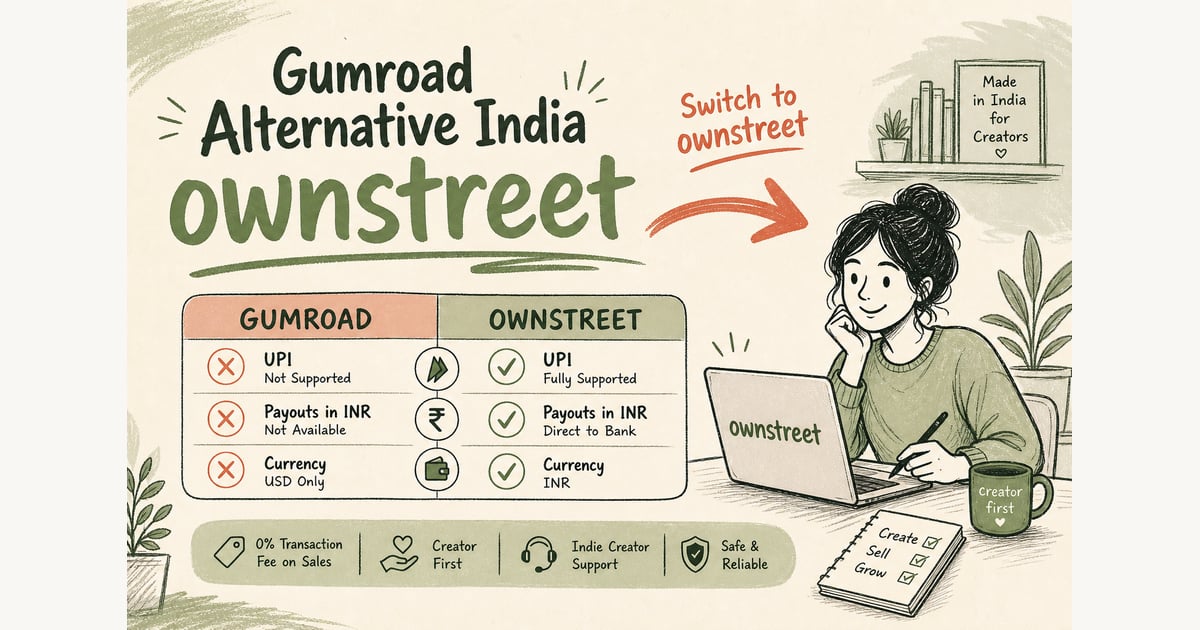
You are likely facing one of three problems: high percentage fees, checkout friction for Indian buyers, or a fragmented stack where links, products, and audience capture live in separate tools. In 2026, many Indian sellers also want UPI checkout without spending a week on Razorpay merchant signup. ownstreet supports bank payouts on Free (bank account + PAN) or your own Razorpay keys. For a direct head-to-head, read ownstreet vs Gumroad. India payment-link cousin: Instamojo alternative India. MoR checkout cousin: Lemon Squeezy alternative India. This guide gives you the framework to pick a better platform, protect margins, and improve conversion.
Quick answer
the right Gumroad alternative in India is the one that aligns with Indian payment behavior (UPI-first), supports INR-native pricing, and avoids margin-killing fee structure on every sale.
Why Indian creators are actively searching for a Gumroad alternative
Gumroad is a well-known global platform. It is fast to launch and trusted by many buyers worldwide. But Indian creators selling mostly to Indian audiences often face structural mismatch. Your buyers expect UPI. Your pricing strategy needs INR sensitivity. Your conversion path must feel local, fast, and trustworthy. When core buying behavior and checkout behavior are misaligned, conversion suffers before your product quality is even evaluated.
- Transaction economics can become expensive as volume grows.
- International-first checkout assumptions reduce India conversion rates.
- You still need another tool for link-in-bio + top-funnel conversion.
- Audience ownership (email capture + retargeting flow) is often fragmented.
The real evaluation framework (not just feature checkboxes)
Most comparison posts fail because they compare UI screenshots. Serious creators should compare economics and conversion leverage. The best gumroad alternative india choice is not the prettiest dashboard. It is the platform that improves net retained revenue over 12 months while reducing tool complexity.
| Evaluation layer | What to measure | Why it matters |
|---|---|---|
| Unit economics | Platform fee + gateway cost + hidden overhead | Profit compounds or decays here |
| Checkout fit | UPI support, mobile flow speed, trust cues | Direct impact on completed sales |
| Stack compression | Links + store + lead capture in one place | Less leakage across tools |
| Retention inputs | Email capture, follow-up capability, analytics | More repeat sales |
| Operational simplicity | Refund flow, product updates, support load | Saves founder time weekly |
Fee math most creators ignore (and regret later)
Open gumroad.com/pricing and copy the Direct row and the Discover row into a sheet before you compare. On 29 Sep 2026 that page was not re-fetched for this edit, so this post does not state a Gumroad percent. If you sell a steady rupee volume, a percent of every sale and a flat monthly plan are different shapes. Write your last 30 days of sales next to whatever those two rows say, then compare that to ownstreet at 0% platform fee plus the Razorpay gateway.
- Write last month's sales total, then apply the Direct row from gumroad.com/pricing. Do not use a percent from memory.
- Do the same sheet at a higher month so you see whether a percent grows faster than a flat plan.
- If some orders are marked Discover, use the Discover row on that same pricing page, not a guessed cut.
- Compare the total to ownstreet Pro at ₹299/month plus Razorpay gateway fees on Razorpay pricing.
This is why pricing architecture matters more than aesthetics. A flat platform model plus standard payment processing often wins for creators with predictable sales cadence.
UPI is not optional in India-first creator funnels
When your audience is Indian, UPI is behavioral infrastructure. If checkout forces card-heavy flows, drop-off increases. Low-friction payment methods are not a growth hack; they are baseline conversion hygiene. For official ecosystem references, review RBI and NPCI.
What high-converting Indian checkout usually includes
- UPI-first placement in payment options.
- Clear INR pricing with no ambiguity.
- Mobile-optimized checkout in minimal steps.
- Simple post-payment delivery and receipt flow.
- Trust markers (brand consistency, support clarity).
Platform comparison: Gumroad vs India-first alternatives
Use this comparison as an operating guide, not brand rhetoric. Your decision should prioritize profit retention, conversion quality, and long-term stack simplicity.
| Dimension | Gumroad setup | India-first alternative setup |
|---|---|---|
| Core model | Global product-selling flow | Local payment + conversion-first flow |
| Pricing feel | Can skew international-first | INR-native positioning |
| Checkout behavior | May not prioritize UPI | UPI-first is central |
| Bio link + store unification | Usually split stack | Single destination strategy |
| Retention infrastructure | Depends on external tools | Often built-in or tightly integrated |
India peers in 2026 (one-line map)
- **GetSauce:** India browse marketplace on getsauce.in; confirm live free-tier and paid fees there (do not assume a fixed %). Deep dive: ownstreet vs GetSauce.
- **Instamojo:** Payment links and MSME store; digital fees are plan-dependent (online payments often list digital files at 5% + ₹3 + GST on the fee; store tables can show higher digital rows on cheaper plans). Confirm on Instamojo pricing. Deep dive: Instamojo alternative India.
- **Playto:** Community spaces and memberships first; file checkout is secondary. Deep dive: Playto alternative India.
How to migrate from Gumroad without losing momentum
Step 1: Export product and customer intelligence
- List top 20% products by revenue contribution.
- Document refund reasons and support friction points.
- Segment existing customers by repeat potential.
Step 2: Rebuild offer architecture (not just pages)
Do not copy old pages blindly. Rewrite product pages with outcome-first headlines, stronger CTA hierarchy, and localized pricing anchors.
Step 3: Launch dual-run for 7 to 14 days
- Keep old links active while new stack stabilizes.
- Route new social traffic to the new destination first.
- Compare click-to-checkout and checkout completion rates.
Step 4: Consolidate once new funnel wins
Once conversion and support burden improve, fully consolidate links and CTAs. Fragmented tool stacks usually create hidden operational drag that compounds over time.
Internal resources to execute faster
- For broader market context, read Creator Economy India 2026 Guide.
- For practical setup, use How to Sell Digital Products in India.
- For link-in-bio landscape analysis, see Best Linktree Alternatives India 2026.
- Compare live plans and economics on Pricing.
- Pick conversion-oriented designs on Templates.
- Collect early buyers through Waitlist.
External references for due diligence
- Payment method and checkout docs: Razorpay Docs.
- Policy-level payments context: Reserve Bank of India.
- UPI ecosystem context: NPCI.
- Macro creator market snapshots: Statista.
- Tax process and filing references: GST Portal.
What changed for Gumroad sellers in India (2026)
- UPI is default buyer behavior on mobile. Card-only or USD-first checkout still leaks sales.
- Bank payouts on ownstreet Free let you skip Razorpay merchant signup for your first product (bank + PAN).
- 0% ownstreet platform fee on product sales beats percentage platform cuts (confirm rival fees on their live pricing page) as volume grows.
- One bio page with links, store, and UPI checkout beats a two-hop foreign stack for Reels traffic.
Still comparing UPI support? Read Does Gumroad support UPI. Bank payout setup: ownstreet bank payout how it works. Fee breakdown: Gumroad fees India.
Common mistakes when choosing a Gumroad alternative in India
- Choosing by UI theme instead of conversion economics.
- Ignoring payment behavior of Indian buyers.
- Keeping links/store/email in disconnected tools.
- Migrating everything at once without a validation window.
- Not measuring pre-vs-post conversion metrics.
Delivery paths that reduce DMs for creators
Automatic delivery after UPI beats "I will send the file tonight." Buyers forgive plain design; they do not forgive silence.
- Success screen + email both carry access.
- Test with a second account.
- Document install steps for templates.
- Keep the master file private.
- See the marketplace.
Fair competitor research rules for creators
Open the other product’s live pricing and help pages this week. If a number is not on that page, do not put it in your blog or pitch.
- Screenshot the fee row with the date.
- Compare jobs: UPI, INR, delivery, marketplace.
- Migrate one bestseller first.
- ownstreet: 0% platform fee on sales.
- Compare plans: Pricing.
The bottom line
The best Gumroad alternative for Indian creators is not a trend choice. It is a business decision around retained margin, local payment fit, and conversion reliability. If you are building a long-term creator business in India, prioritize platforms that reduce friction and increase ownership across audience and revenue.
FAQ: Gumroad Alternative for India
Does Gumroad support UPI for Indian buyers?
Gumroad is not built UPI-first. Indian buyers often drop when checkout feels international. Full breakdown: Does Gumroad support UPI.
Can I switch without my own Razorpay merchant account?
Yes on ownstreet Free with bank payouts (bank account + PAN, 1 live product). Or connect your own Razorpay keys if you already have them. Guide: Bank payouts digital products India.
What is the best Gumroad alternative in India for beginners?
For most beginners, the best option is a platform that combines bio links, digital products, and UPI-friendly checkout in one place. Reducing tool complexity improves focus and execution speed.
Should I move if I only have one product?
If your current setup causes checkout friction or margin loss, yes. Even one-product funnels benefit from better payment fit and cleaner conversion paths.
How long does migration usually take?
A focused migration can be done in 2-7 days depending on catalog complexity, copy rewrite scope, and analytics setup.
Share this post
Further reading

ownstreet team
Monetization Strategy · ownstreet
Updated Sept 2026