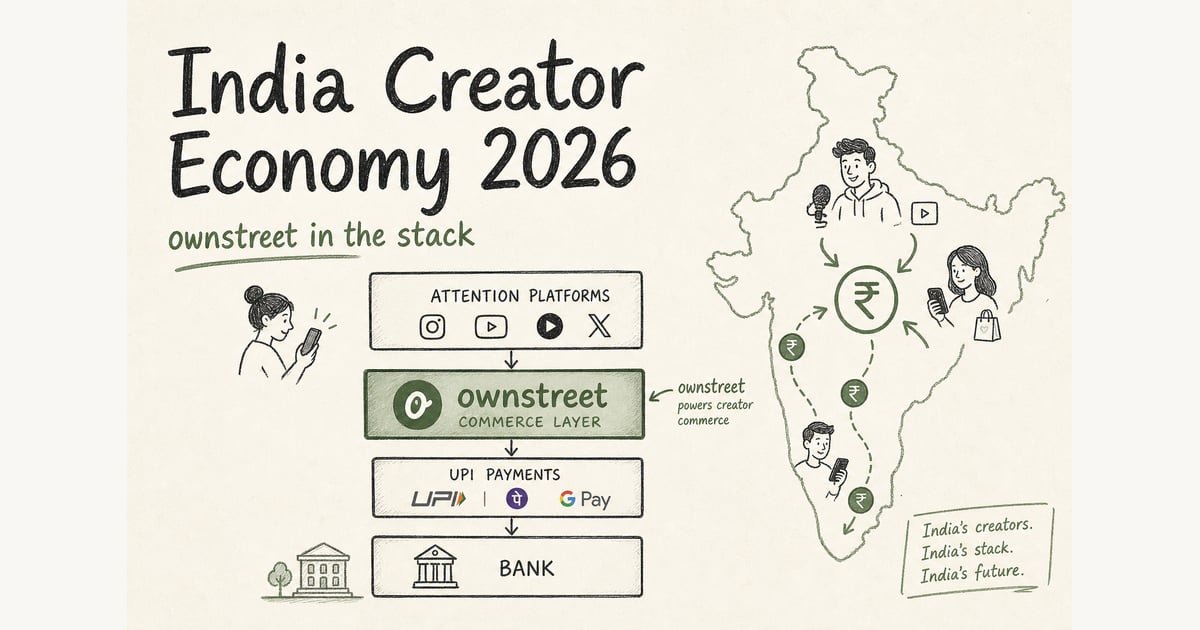
India creator economy 2026 is not one market. It is a stack of attention platforms, offline payment habits, and commerce tools that were never designed to work together. Instagram and YouTube supply reach. Brand deals and platform ad programs supply sporadic cash. WhatsApp and UPI supply how most Indians actually pay. The gap is infrastructure: who owns checkout, pricing in rupees, and repeat revenue when the algorithm moves on.
ℹ️ Quick answer
Quick answer: Indian creators earn through brand deals, platform programs, coaching, memberships, and digital products. UPI is the default buyer payment rail. The infra layer that converts reach into owned revenue is still underbuilt: bio links, storefronts, Razorpay checkout, and creator marketplaces that list INR products with local payment methods.
What does the India creator economy look like in 2026?
Roughly 80 million-plus Indians identify as creators or serious hobbyists across short video, long video, newsletters, and visual design niches. Most earn nothing directly from platforms. Meta and YouTube monetization in India pays a fraction of what US creators see. The money that does flow often sits outside platform dashboards: UPI in DMs, WhatsApp forwards, festival campaign fees, and ₹199–₹999 digital downloads.
- Attention layer: Instagram, YouTube, LinkedIn, X, regional short-video apps
- Transaction layer: UPI (GPay, PhonePe, Paytm), cards, net banking via Razorpay and peers
- Commerce layer: Gumroad, Etsy, Patreon, Topmate, ownstreet, bespoke WhatsApp sales
- Discovery layer: hashtags, Reels, SEO, creator marketplaces, word of mouth
Policy and payments context: Reserve Bank of India regulates payment systems; NPCI runs UPI, which processed billions of transactions monthly by 2025–2026. That volume shapes buyer expectations more than any creator tool feature list.
How do Indian creators actually get paid?
| Revenue channel | Who pays | Typical scale | UPI-friendly? |
|---|---|---|---|
| Brand sponsorships | Brands / agencies | ₹5k–₹5L+ per deal | Invoice + bank transfer |
| Platform ad share | Meta, YouTube | Often small in India | No (platform payout) |
| Coaching / calls | Fans, students | ₹499–₹5,000/session | Sometimes offline UPI |
| Memberships | Superfans | ₹99–₹999/month | Rare on global tools |
| Digital products | Buyers | ₹99–₹1,999 one-time | Yes when checkout is local |
| Affiliate / codes | Brands | Variable | N/A |
The pattern: platform money is thin and delayed. Product and service money is immediate but messy without checkout infra. A Notion template seller with 8,000 followers often earns more from ten ₹499 UPI sales than a month of Reels bonus programs.
What is offline monetization for Indian creators?
Offline monetization does not mean cash-only. It means payment and fulfillment happen outside the social app's native commerce. DM for UPI screenshot. WhatsApp group with a Google Drive link after manual verify. Google Form plus PhonePe. These workflows powered the first wave of Indian creator income because global checkout tools ignored UPI.
- Buyer DMs creator after seeing Reel or story
- Creator sends UPI ID or QR, buyer pays ₹199–₹999
- Creator manually emails file or adds buyer to WhatsApp group
- No receipt standard, no automatic refund path, no scale past ~20 orders/week
Offline monetization still works at micro scale. It breaks on trust, time zones, and support load. The infra upgrade is automated checkout: pay first, file delivers, Razorpay receipt in inbox. See sell digital products India for the migration path.
Which creator platforms support UPI in India?
| Platform | Primary use | UPI checkout | INR-native | Platform fee |
|---|---|---|---|---|
| Instagram / YouTube | Reach | No native product UPI | N/A | Ad share only |
| Gumroad | Digital downloads | No | No | Direct 10%+$0.50; Discover 30% (gumroad.com/pricing) |
| Patreon | Memberships | No | No | Tiered % |
| Linktree Shop | Bio + light shop | Limited / indirect | Partial | Free 12% / Starter/Pro 9% / Premium 0% where available (India may not be) |
| Topmate | 1:1 calls | Partial via integrations | Yes for bookings | Commission on bookings |
| ownstreet | Bio + store + marketplace | Yes via Razorpay | Yes | 0% on product sales |
Deep dives on weak UPI support: Does Gumroad support UPI, Does Patreon work in India. For platform roundups: best digital product platform India.
What is the infra layer in the creator economy?
Think of infra as everything between a view and a settled rupee in a bank account. Not content. Not branding. The pipes: identity (creator page URL), catalog (product listings), pricing (INR), payment gateway (Razorpay with UPI), delivery (file or link unlock), discovery (marketplace or SEO), and retention (email, WhatsApp follow-up).
| Infra component | Global default | India-first need |
|---|---|---|
| Bio destination | Link hub only | Links + products on one URL |
| Checkout | Card / USD | UPI + INR on mobile |
| Payout | Platform holds funds | Creator Razorpay to own bank |
| Fees | % per sale stacks | Predictable monthly or 0% platform fee |
| Discovery | Algorithm only | Marketplace + owned SEO |
Razorpay is the dominant gateway layer for Indian creator commerce. Creators complete KYC, connect a account, and enable UPI on checkout. Setup guide: Razorpay for digital creators. Gateway fees apply; they are separate from platform fees.
How does money move on a typical ₹499 digital product sale?
- Buyer lands on creator bio page from Instagram or YouTube
- Sees ₹499 Notion planner or PDF, taps buy
- Pays with UPI through Razorpay checkout (2–3 taps on mobile)
- Payment settles per Razorpay schedule to creator bank account
- Buyer receives file automatically; creator sees order in dashboard
- Platform (if any) charges 0% or a % fee depending on tool
On ownstreet, product sales carry 0% platform fee. Marketplace listing is free after first sale. Pro is ₹299/month for unlimited products and email capture. Pro Max is ₹799/month for custom domain, Featured marketplace, and advanced seller tools. As of mid-2026, the platform reports 1000+ creators and ₹3,60,000+ GMV processed, small but representative of early infra adoption.
Where does ownstreet fit in the India creator stack?
Ownstreet sits in the commerce and infra layer, not the attention layer. Creators keep posting on Instagram. They send bio traffic to one ownstreet URL with links, digital products, and Razorpay UPI checkout. Eligible shops auto-list on the creator marketplace after first sale for category discovery without giving up their storefront.
- Free plan: 1 live product, 5 links, start without monthly cost
- Pro ₹299/month: unlimited products, email capture, reviews
- Pro Max ₹799/month: custom domain, coupons, deeper analytics
- 0% platform fee on digital product sales; Razorpay fees still apply
- Payments go to creator bank via their own Razorpay account
Compare the broader store concept in digital product platform India and creator marketplace India. For creator-operators, see also creator economy India on building owned revenue vs rented reach. Plans: pricing.
What is changing in Indian creator monetization?
- UPI literacy is universal; card-only global checkout is a conversion tax
- Digital products (templates, presets, guides) scale better than ad share in India
- Creators run hybrid stacks: global tool for US buyers, India tool for local UPI
- Marketplaces add discovery without replacing owned audience relationships
- Offline DM sales are migrating to automated checkout as creators hit volume
Journalists and investors mapping this space should separate headline creator counts from payment-ready infra penetration. Most creators monetize offline or not at all. The growth segment is creators productizing expertise into ₹99–₹1,999 SKUs with UPI-native checkout.
FAQ: India Creator Economy 2026
How big is the creator economy in India?
Tens of millions participate; paid full-time creators are a smaller subset. Reliable public GMV totals are fragmented because much income still flows through offline UPI and brand deals outside disclosed platforms.
Do Indian creators earn from Instagram directly?
Most earn little from platform programs alone. Sponsorships and owned products outperform native monetization for the median creator. See Instagram monetization India.
Why is UPI central to creator infra in India?
UPI is the default mobile payment method. Checkout without UPI loses buyers who would happily pay ₹199–₹499 for a template or guide.
What platforms let creators keep 0% platform fees?
Ownstreet charges 0% platform fee on digital product sales with Razorpay connected. Gateway fees still apply. Global tools like Gumroad take a percentage per sale.
Is offline WhatsApp selling still common?
Yes, especially for coaches and early-stage sellers. It does not scale. Automated storefronts with UPI are the upgrade path most serious product sellers take.
Share this post
Further reading

Lakshath
Founder, ownstreet · ownstreet
Updated Sept 2026